2027 Speech Pathology Degree Salary by Experience Level: Entry-Level, Mid-Career, and Senior Roles

Co-Founder and Chief Data Scientist

Reviewed by Rhea Paul, PhD
SLP Education & Research Expert
A speech pathology degree can lead to stable clinical work, but the salary picture changes sharply by experience level, employer, setting, and location. For students, recent graduates, and working speech-language pathologists, the key question is not only “What can I earn now?” but “How does compensation grow as I build clinical expertise, credentials, and leadership responsibility?”
According to the U.S. Bureau of Labor Statistics, employment of speech-language pathologists is projected to grow 17% through 2035, signaling strong demand across schools, hospitals, rehabilitation centers, private clinics, and related care settings. Demand alone, however, does not guarantee top pay. Entry-level salaries often differ substantially from mid-career and senior earnings, and the best-paying paths usually require strategic choices about specialization, work environment, geographic market, and professional development.
This guide breaks down speech pathology degree salary progression from entry-level roles to senior positions. It explains typical salary ranges, the factors that influence raises, which industries tend to pay more, and how professionals can improve long-term earning potential without relying on vague career advice.
Key Things to Know About Speech Pathology Degree Salary By Experience Level
- Entry-level speech pathology salaries typically range from $55,000 to $70,000, influenced by location, internships, certifications, and employer type such as hospitals or schools.
- Mid-career professionals earn $75,000 to $95,000, with increases driven by experience, specialization in areas like pediatric or geriatric care, and pursuing advanced credentials.
- Senior roles can exceed $100,000, often involving leadership, management responsibilities, niche expertise, and employment in high-demand sectors like healthcare administration or research.
What is the average speech pathology degree salary by experience level?
The average speech pathology degree salary generally rises as clinicians gain independent judgment, stronger case-management skills, and the ability to serve more complex populations. Across many career paths, salary growth from entry-level positions to senior roles may reflect an average increase of 25% to 35%, especially when professionals add specialization, supervisory duties, or advanced clinical responsibilities.
Experience matters because employers pay not only for credentials but also for proven clinical decision-making. A new graduate may still be building confidence with assessments, documentation, treatment planning, and family or team communication. A senior speech-language pathologist may lead programs, mentor staff, manage complex caseloads, or contribute to research and administrative strategy.
| Experience level | Typical salary range | Common responsibilities |
| Entry-level roles | $55,000 to $70,000 annually | Supervised or closely supported clinical work in schools, healthcare facilities, rehabilitation centers, or similar settings |
| Early career | $65,000-$80,000 annually | More independent caseload management, stronger therapy planning, and possible early specialization in pediatric or adult treatment |
| Mid-career | $80,000 to $95,000 annually | Advanced clinical techniques, higher caseload complexity, mentoring, or limited supervisory responsibilities |
| Senior-level roles | $95,000 to $110,000 or more annually | Leadership, administration, specialized practice, research involvement, program oversight, or private practice development |
When evaluating average earnings, look beyond the base salary. Benefits, school-year versus year-round schedules, productivity expectations, continuing education support, loan repayment eligibility, and caseload size can all change the real value of a job offer.
Professionals comparing advanced healthcare education options sometimes review adjacent pathways such as a 1 year MSN to DNP program online, but speech pathology salary growth is most directly tied to licensure, clinical specialization, setting, and leadership opportunities within speech-language pathology.
What is the starting salary for entry-level speech pathology graduates?
Entry-level speech pathology graduates commonly see starting pay between $50,000 and $75,000 annually, depending on employer type, region, clinical placement experience, and whether the role is school-based, healthcare-based, or in private practice. According to the U.S. Bureau of Labor Statistics, the median wage for speech-language pathologists hovers around $97,870, which shows that the field has solid earning potential even though new graduates may start below experienced clinicians.
Starting salary should be evaluated alongside supervision quality and career mobility. A first job with a slightly lower salary may still be valuable if it provides strong mentorship, a manageable caseload, licensure support, and exposure to high-demand populations. Conversely, a higher starting salary may come with heavier productivity requirements or less structured support.
- Speech-Language Pathologist: Entry-level speech-language pathologists assess and treat communication disorders in children and adults. Starting salaries generally range from $60,000 to $75,000 annually, with healthcare settings and private practice opportunities often influencing compensation.
- Early Intervention Specialist: These professionals support young children with developmental delays and often work closely with families, pediatric providers, and community agencies. Entry-level pay often falls between $50,000 and $65,000, depending on region and employer type.
- School-Based Speech Therapist: School-based clinicians help students address speech and language challenges that affect learning and participation. Typical starting salaries range from $55,000 to $70,000, and benefits, school-year schedules, pension access, and caseload expectations can meaningfully affect total compensation.
- Rehabilitation Therapist: Rehabilitation-focused roles support patients recovering from trauma, neurological conditions, or other medical events that affect communication and swallowing. Initial salary brackets are commonly between $58,000 and $72,000, with variation by medical facility and internship experience.
Recent graduates should compare job offers by asking specific questions: How many clients or students are assigned? Is supervision included? Are continuing education costs covered? Are documentation hours paid? Are there opportunities to move into specialty caseloads? These answers can matter as much as the first-year salary figure.
Some professionals researching broader healthcare education may also review DNP programs, but entry-level speech pathology graduates should prioritize state licensure requirements, clinical fellowship expectations, and employer support for professional growth.
How much do mid-career speech pathology professionals earn after 3-5 years?
After three to five years, speech pathology professionals often move from entry-level compensation of about $50,000-$65,000 into an average range near $65,000-$85,000 annually. This stage may bring a 10-15% increase as clinicians become more efficient, document stronger outcomes, handle complex cases, and qualify for roles that require less direct supervision.
Mid-career salary growth is rarely automatic. Employers are more likely to increase pay when a clinician can show measurable value: improved client outcomes, experience with high-need populations, reliable compliance documentation, family and interdisciplinary collaboration, and the ability to mentor newer staff. Specialization in pediatric or neurological speech disorders can also improve negotiating power, particularly in hospitals, rehabilitation centers, and high-demand local markets.
What tends to drive raises after 3-5 years?
- Clinical independence: Employers value clinicians who can evaluate, plan, treat, and adjust interventions with minimal support.
- Specialized caseload experience: Work with pediatric, neurological, swallowing, AAC, or medically complex cases can make a candidate more competitive.
- Stronger productivity and documentation: Efficient scheduling, timely notes, and compliance with payer or school requirements can affect compensation decisions.
- Setting changes: Moving from one employment environment to another may create a larger salary jump than waiting for annual raises.
- Added responsibility: Informal mentoring, team coordination, and program support can lead to supervisory or lead clinician roles.
One professional described the mid-career transition this way: “Initially, the jump wasn't huge, but by year three, better evaluations and new responsibilities reflected in a stronger paycheck.” That experience reflects a common pattern: the largest early salary gains often come when a clinician can connect improved skills with specific workplace needs.
A common mistake at this stage is waiting until an annual review to discuss pay. Mid-career clinicians should track accomplishments throughout the year, including caseload complexity, successful interventions, continuing education, leadership contributions, and examples of improved client or program outcomes.
Speech pathology professionals with over 10 years of experience often earn between $75,000 and $105,000 annually, with top earners surpassing $115,000 depending on sector, location, specialization, and leadership scope. At this level, pay is usually tied less to years alone and more to the value of advanced expertise, program oversight, administrative responsibility, or highly specialized clinical practice.
Senior clinicians who remain in direct service roles may still increase earnings by developing niche expertise. Those who move into leadership, consulting, program coordination, or private practice may access higher salary ranges, but those paths often involve trade-offs such as administrative burden, business risk, staff management, or productivity targets.
| Senior role | Typical salary range | Why compensation may be higher |
| Clinical Director | $90,000 to $115,000 | Oversees departments, manages staff, sets treatment protocols, and supports service quality |
| Specialized Therapist | $80,000 and $110,000 annually | Provides advanced care in areas such as pediatric or neurological disorders where specialized skills are in demand |
| Healthcare Consultant | $85,000 to $120,000 | Advises institutions or private practices on speech pathology services, operations, compliance, or care models |
| Educational Coordinator | $75,000 to $100,000 | Develops programs and supervises speech therapy services in schools or universities |
Senior professionals should be careful not to assume that tenure alone will produce top-of-range compensation. The strongest salary cases usually combine experience with evidence of leadership, difficult-to-find clinical skills, program growth, strong outcomes, or the ability to improve service delivery.
Advanced certifications, leadership training, and awareness of metropolitan market demand can help experienced speech pathology professionals protect and expand earning potential. Some clinicians exploring supplemental administrative or revenue-cycle knowledge may review resources on financial aid for medical billing and coding, although salary growth in speech pathology primarily depends on clinical scope, setting, licensure, and leadership track.
Speech pathology salary progression is generally steady rather than sudden. From entry-level to senior positions, salaries typically rise by approximately 60% to 70%, especially for professionals who add specialized skills, credentials, leadership duties, or higher-paying employment settings. The career path is not one fixed ladder, however. A school-based clinician, hospital specialist, private practitioner, and administrator may all follow different compensation timelines.
| Career stage | Typical salary range | Main reason pay increases |
| Entry-level | $55,000 and $65,000 | Transition from academic preparation into supervised or early independent practice |
| Early career | $65,000-$75,000 | Skill refinement, stronger documentation, licensure progress, and broader caseload experience |
| Mid-career | $75,000 and $90,000 | Promotions, specialization, leadership opportunities, or work with pediatric or geriatric speech therapy |
| Senior-level | Over $90,000, sometimes exceeding $110,000 | Supervisory duties, program development, private practice, or advanced clinical expertise |
A speech pathology degree graduate reported that after several years near the entry-level range, additional certifications and a shift into specialized pediatric therapy increased salary by around 30%. Later, management responsibilities raised compensation further. That pattern illustrates an important point: the largest long-term gains often come from combining clinical specialization with responsibility for people, programs, or revenue-producing services.
To evaluate salary progression realistically, compare both short-term and long-term trade-offs. School roles may offer schedule stability and benefits. Hospitals may provide exposure to medically complex cases and stronger pay potential. Private practice may allow higher upside but can involve billing, client acquisition, and business risk. The best path depends on whether a professional values predictable compensation, clinical specialization, leadership, autonomy, or entrepreneurial growth.
The biggest salary-growth factors in speech pathology are experience, specialization, work setting, geography, and leadership responsibility. Professionals with over ten years of experience can earn up to 40% more than those just starting, but time in the field is only one part of the equation. The highest long-term earnings usually come from pairing experience with skills that employers urgently need.
- Experience Accumulation: Pay typically rises as clinicians build hands-on expertise, improve judgment, and develop a record of effective patient or student outcomes. Employers reward professionals who can manage complex caseloads reliably and reduce the need for close supervision.
- Specialized Expertise: Skills in pediatric speech disorders, neurogenic communication issues, swallowing disorders, AAC, or related specialty areas can increase market value. Specialization is especially useful when local employers have a shortage of clinicians with those competencies.
- Work Environment: Salaries vary across healthcare facilities, private clinics, educational institutions, and rehabilitation settings. Higher-funded or higher-demand environments may offer stronger salary growth, but they may also involve higher productivity expectations, medical complexity, or administrative pressure.
- Geographic Variations: Urban centers and higher-cost regions often pay more, but a higher salary does not always mean greater purchasing power. Professionals should compare salary against housing, commute costs, taxes, benefits, and local job stability.
- Leadership Roles: Supervising clinicians, mentoring new staff, managing programs, or coordinating services can significantly increase compensation. Leadership also changes the nature of the job, shifting time from direct client care to planning, personnel management, and performance improvement.
Common salary-growth mistakes
- Choosing a job based only on annual salary without reviewing caseload, benefits, supervision, and unpaid work expectations.
- Waiting too long to specialize in an area with strong employer demand.
- Assuming annual raises will match market value without comparing current pay to similar roles.
- Not documenting accomplishments before salary negotiations.
- Ignoring the financial impact of location, schedule, and benefits.
Location can change speech pathology salaries substantially because pay is shaped by cost of living, regional demand, employer concentration, and public funding. In the United States, salary variations can reach up to 30% between urban and rural areas, so geographic strategy can be one of the most important compensation decisions a clinician makes.
- Urban Centers: Metropolitan areas like New York City and San Francisco often offer salaries 20% to 30% higher than rural regions. The premium may reflect higher living costs, denser populations, and greater demand across hospitals, schools, clinics, and specialty care settings.
- High-Demand States: States such as California and Texas show median wages approximately 15% above the national median. Strong healthcare infrastructure and educational funding can attract skilled professionals and increase salary competition.
- Rural Areas: Smaller towns and rural regions may offer lower salaries because there are fewer specialized employers and less local demand. However, these areas may also provide lower living costs or loan forgiveness programs to attract speech pathologists.
- Industry Concentration: Regions with many hospitals, rehabilitation centers, schools, and private clinics create stronger competition for qualified clinicians. That competition can support higher wages, particularly for professionals with specialized experience.
- Public Funding Variability: State and local budgets affect government-funded and school-based positions. Areas with higher public investment in speech pathology services may offer stronger compensation packages.
Before relocating for a higher salary, compare the full financial picture. A position paying more in a high-cost metro area may not improve net income if rent, transportation, taxes, licensing fees, and childcare are substantially higher. On the other hand, a rural or underserved area may offer valuable incentives, broader clinical responsibility, and faster leadership opportunities.
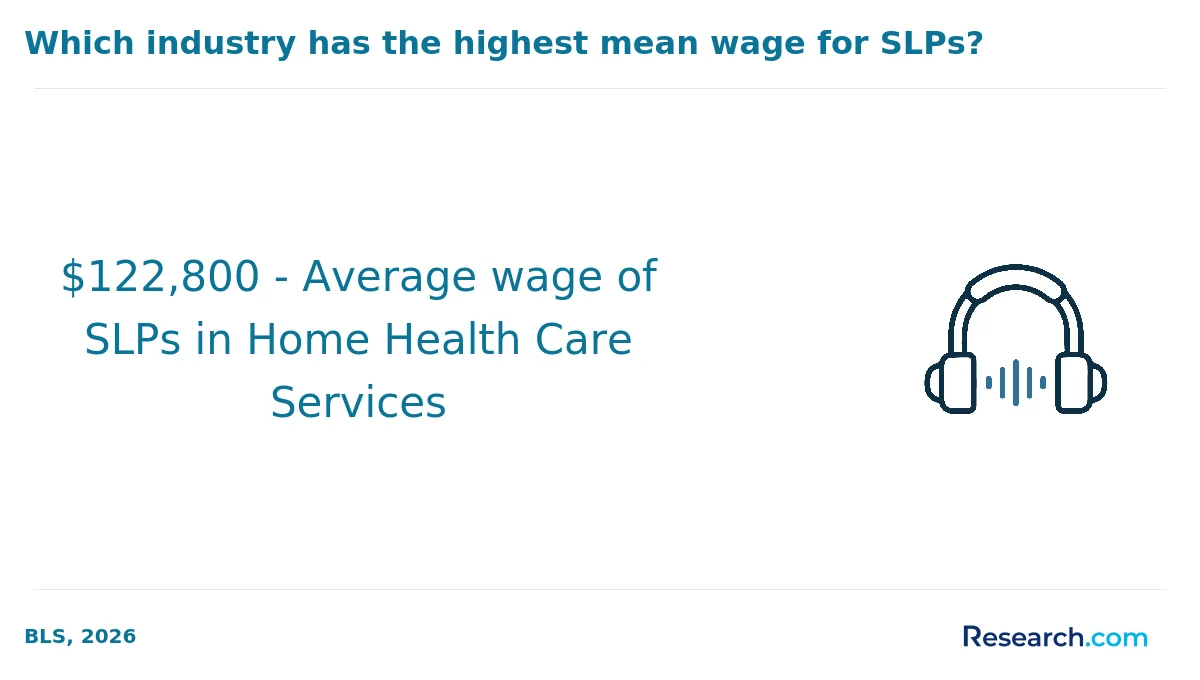
Industry choice has a major effect on speech pathology salary potential. About 20% of professionals in speech pathology earn above $100,000 annually when employed in the highest paying industries. These higher-paying environments tend to require advanced clinical judgment, specialized treatment skills, regulatory knowledge, or the ability to work with complex patient or client needs.
- Healthcare Systems and Hospitals: Large hospital networks and healthcare organizations often pay more for experienced speech pathologists who can support patients with complex medical needs, including stroke or traumatic brain injury recovery. Senior roles such as clinical coordinator or rehabilitation manager may require advanced clinical skills, interdisciplinary collaboration, and service-quality oversight.
- Educational Services and Special Education Programs: Public and private educational institutions employ speech pathologists to support students with communication needs and to contribute to individualized education plans (IEPs). Lead therapist and program director roles may offer higher salaries, especially when responsibilities include compliance, staff support, and program coordination.
- Corporate and Technology Sectors: Technology companies working on speech recognition, augmentative communication devices, and AI-driven therapy tools may hire speech pathology experts as clinical consultants or product developers. These roles can pay premiums when professionals combine clinical knowledge with product strategy, usability insight, and innovation.
The best-paying industry is not always the best fit for every clinician. Hospitals may offer stronger compensation but involve medically complex cases and fast-paced care. Schools may offer stability and defined calendars but may have salary schedules that limit rapid growth. Corporate roles may offer higher upside but require comfort with technology, product development, or nontraditional clinical work.
For those considering advanced leadership in healthcare organizations, a healthcare PhD programs online search may provide context on management-oriented academic routes, though speech pathology graduates should weigh any doctoral path against cost, career goals, and expected return.
Yes. Specialized skills and industry-recognized certifications can increase speech pathology salary potential because they signal advanced competence in areas employers find difficult to staff. Studies show that advanced certifications can increase salary growth by up to 15%, particularly for mid-career and senior professionals competing for specialized or leadership roles.
The return on a certification depends on whether the credential aligns with employer demand. A certification is most valuable when it helps a clinician qualify for higher-complexity caseloads, leadership responsibilities, private practice services, or roles in settings with stronger compensation budgets.
- Clinical Specializations: Certifications or advanced training in swallowing disorders, pediatric speech, or neurogenic communication disorders can support premium pay because they prepare clinicians for complex cases and specialized care settings.
- Advanced Therapeutic Techniques: Evidence-based approaches such as PROMPT or Lee Silverman Voice Treatment (LSVT) can make a clinician more marketable when employers need targeted intervention expertise.
- Technological Proficiency: Skill with augmentative and alternative communication (AAC) devices and telepractice platforms can improve employability, especially in private practice, schools, remote service models, and technology-linked therapy environments.
- Leadership and Program Development: Training in healthcare management, educational consulting, supervision, or program design can help speech pathologists move into roles with higher compensation and broader organizational impact.
High-paying opportunities for speech pathologists are often found in healthcare, private practice, research, and private educational institutions. Hospitals and rehabilitation centers may offer premium pay because clinical complexity and regulatory requirements are high. Private practices may reward entrepreneurial ability and specialized services. Research organizations value advanced academic preparation and innovation, while private school systems may offer different compensation structures because of tuition-supported funding and smaller caseloads.
Salary patterns in other allied health fields can offer useful comparison points; for example, Psychiatric mental health nurse practitioner salary data also shows how specialization and setting can affect compensation.
Maximizing speech pathology salary requires different moves at different points in the career. Early-career professionals should focus on building strong clinical foundations and completing licensure requirements. Mid-career clinicians should develop specialized skills and negotiate based on documented value. Senior professionals should decide whether they want to grow through advanced clinical expertise, leadership, consulting, private practice, or program administration.
| Career stage | Best salary strategy | What to avoid |
| Entry-level | Choose roles with strong supervision, broad clinical exposure, and a clear path toward independent practice | Taking the highest offer without considering caseload, supervision, documentation burden, or benefits |
| Early career | Build measurable skill in high-demand populations and track outcomes, productivity, and professional development | Waiting passively for annual raises without gathering evidence of growth |
| Mid-career | Pursue targeted certifications, specialty caseloads, and lead clinician responsibilities | Collecting credentials that do not match employer demand or local market needs |
| Senior-level | Move into program leadership, consulting, advanced specialty practice, or private practice if aligned with career goals | Assuming years of experience alone will justify top-of-range pay |
- Skill Diversification: Early-career speech pathologists should build a broad clinical base before narrowing into a specialty. This improves job mobility and helps clinicians identify which populations and settings fit their strengths.
- Professional Certification: Mid-career clinicians can benefit from credentials such as Board Certified Specialist when the credential supports a clear salary, promotion, or specialization goal.
- Leadership Transition: Senior professionals should develop management, mentoring, budgeting, and program-evaluation skills if they want access to higher-level administrative compensation.
Professionals considering graduate study or a return to school should compare tuition, accreditation, clinical placement support, licensure alignment, and long-term salary goals. For readers researching flexible graduate pathways, online speech language pathology programs can be part of that comparison, especially when affordability and scheduling are major factors.
What Graduates Say About Speech Pathology Degree Salary By Experience Level
- : "As an early-career speech pathology graduate, I've noticed that salaries tend to start modestly but grow steadily with experience and additional certifications. From my perspective, gaining clinical expertise and specializing in pediatric or geriatric care can significantly boost earning potential. It's encouraging to see that healthcare settings like hospitals and private clinics generally offer the most competitive salaries. — Kayden"
- : "Reflecting on my journey in speech pathology, I've observed that salary progression is quite linked to both the amount of hands-on experience and the pursuit of advanced education. Key factors influencing salary increases include licensure, ongoing professional development, and taking leadership roles. From what I've seen, sectors such as education and rehabilitation often provide stable yet somewhat lower pay compared to hospital environments. — Cannon"
- : "With years in the field of speech pathology, I can attest that the salary curve is quite rewarding for those who invest time in building expertise and diversifying their skills. Factors like geographic location and type of employer play a large role in compensation differences, with private healthcare and specialty clinics typically at the higher end of the pay scale. It's a dynamic career path where continuous learning directly translates to financial and professional growth. — Nolan"
Other Things You Should Know About Speech Pathology Degrees
Yes, benefits such as health insurance, retirement plans, and paid leave often increase with experience. Senior speech pathologists are more likely to receive bonuses or profit-sharing options, which supplement their base salary. These benefits enhance overall compensation beyond the stated salary figures.
Continuing education and advanced certifications can lead to salary increases at all career stages. Employers value additional specialties, which may qualify professionals for higher-paying roles or leadership positions in the field.
Yes, settings like hospitals, private practices, and schools offer different salary growth opportunities. Typically, healthcare facilities provide higher potential salary increases compared to educational institutions, impacting long-term earnings by experience level.
In 2027, entry-level speech pathologists can expect to earn an average salary of $55,000, mid-career professionals earn around $97,870, and senior pathologists make approximately $134,160 annually. Salaries vary based on location, specialization, and institutional funding.
- U.S. Bureau of Labor Statistics - Speech-Language Pathologists https://www.bls.gov/ooh/healthcare/speech-language-pathologists.htm
- ASHA EdFind - Accredited Speech-Language Pathology Programs https://find.asha.org/ed/
- O*NET OnLine - Speech-Language Pathologists https://www.onetonline.org/link/summary/29-1127.00
- University of Scranton - Master of Science (M.S.) in Speech-Language Pathology https://www.scranton.edu/academics/pcps/health-and-human-performance/programs/speech-language-pathology/index.shtml
- California State University-San Marcos - Online MS in Speech-Language Pathology https://www.csusm.edu/slp/programs/mastersonline/index.html
- Nova Southeastern University - SLP Program - Master of Science in Speech-Language Pathology https://osteopathic.nova.edu/degrees/masters/speech-language-pathology/index.html
- West Virginia University - Speech-Language Pathology, M.S. - Online https://medicine.hsc.wvu.edu/communications-sciences-and-disorders/speech-language-pathology-ms/future-students/curriculum/online-slp-program/
- Abilene Christian University - Master of Science in Speech-Language Pathology (Online) https://acu.edu/academics/graduate/master-of-science-in-speech-language-pathology/