2027 Choosing Public Health BS Coursework for Environmental Health Laboratories
Audited and Verified:
Our Editorial and Data Verification Process
Research.com uses government datasets, official education statistics and primary institutional information to support its career and degree guides. Our review process checks factual accuracy, occupational definitions, source dates and the requirements associated with the credentials discussed.
How This Article Was Fact-Checked
Our editorial team verifies salary estimates, employment projections, education requirements and program information against original data providers and official organizations. Salary figures are checked against the relevant occupational definitions and reporting periods. Information about licensure, accreditation and required in-person training is reviewed separately.
Fact-checked and verified on:

Co-Founder and Chief Data Scientist
An environmental health laboratory needs people who can produce reliable test results and understand what those results mean for communities. A public health BS can help with the second task, but its required courses may not provide enough chemistry, microbiology, or supervised bench work for the first.
This guide is for students choosing courses or comparing programs with laboratory work in mind. It shows how to match a curriculum to actual job requirements, find applied training, and decide when an environmental science or laboratory-focused degree is the more direct route.
Key Things You Should Know
- For laboratory testing roles, prioritize chemistry, biology or microbiology, quantitative methods, and supervised laboratory courses; public health survey courses alone are not enough.
- Check whether target employers require specific science credits, laboratory experience, or a particular degree before choosing electives or transferring credits.
- Most bachelor's pathways take about four years of full-time study, but prerequisites, lab scheduling, and transfer-credit decisions can change both completion time and cost.
What Is a Public Health BS for Environmental Health Laboratory Careers?
A public health BS studies health at the population level. For an environmental health laboratory career, its value lies in connecting measurements of water, food, air, or other environmental samples to exposure patterns, prevention, and public health decisions.
Laboratory staff, however, must also be able to follow technical methods and document results accurately. Those abilities depend on the program's science and laboratory coursework, not the degree title.
Compare the curriculum with postings for the work you want: sample receiving, analytical testing, environmental microbiology, or exposure-data support. A chemistry, biology, environmental science, or laboratory science major may be more direct if postings emphasize extensive bench training.
A public health BS is especially useful when you also want to interpret findings, communicate with health agencies, or work across testing and prevention teams. To compare broader degree formats before examining individual course catalogs, see public health degrees by price and completion time.
Which Coursework Prepares Public Health BS Students for Environmental Health Laboratories?
The strongest course plan pairs public health context with enough science to meet the entry requirements of your target laboratory. Titles and credit requirements vary, so inspect course descriptions, prerequisites, and whether a course includes an in-person lab.
The comparison below separates foundational study from coursework that provides more direct technical preparation.
| Course area | Why it matters | What to check |
| General and analytical chemistry | Builds understanding of concentrations, calibration, and chemical measurement. | Whether analytical chemistry and its laboratory are available after the general sequence. |
| Biology and microbiology | Supports work involving organisms, contamination, and microbial testing. | Whether the target role calls for microbiology laboratory credits. |
| Environmental health or toxicology | Connects hazards, exposure pathways, and health effects. | Whether the course teaches assessment methods rather than only broad concepts. |
| Statistics and epidemiology | Helps students interpret variation and place results in population-health context. | Whether students practice analyzing and explaining data. |
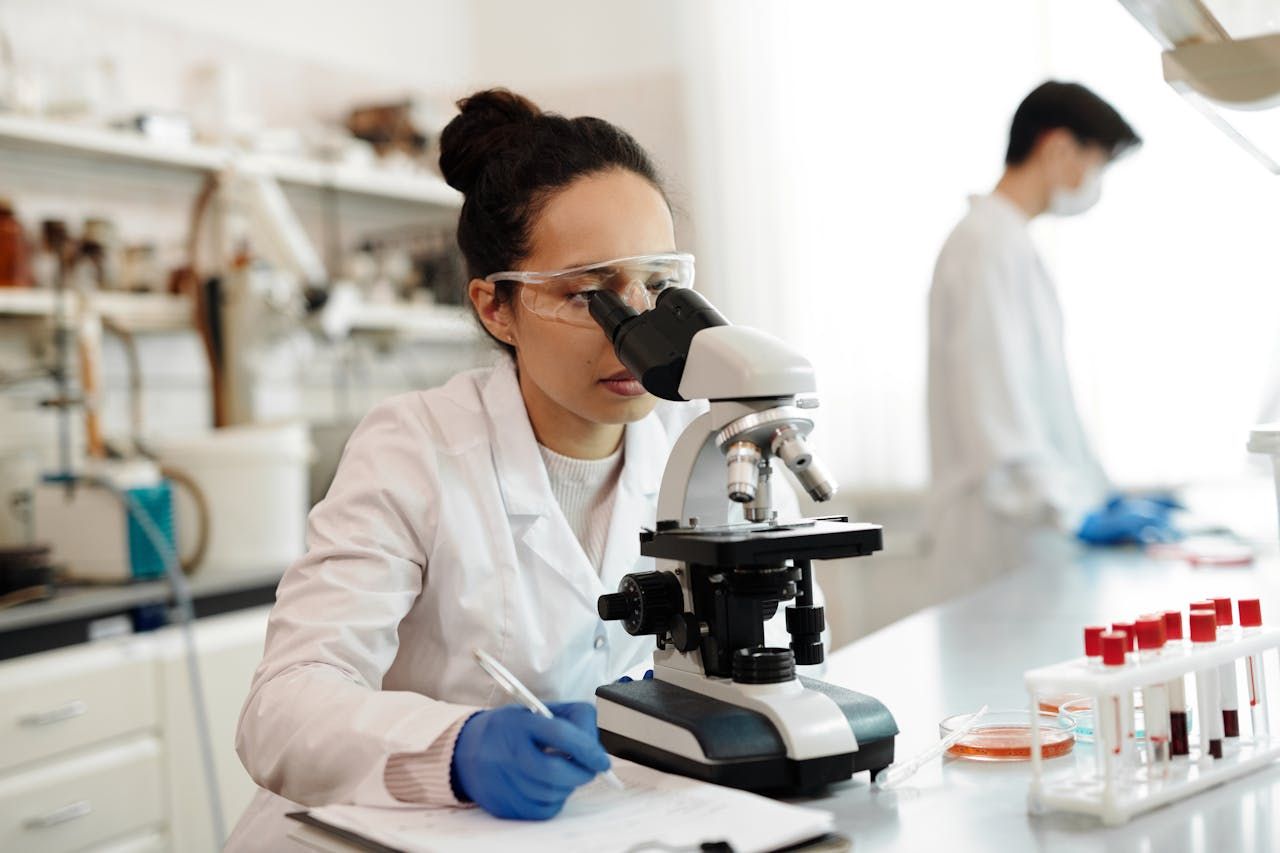
| Laboratory methods or research | Provides practice with instruments, records, quality controls, and troubleshooting. | Actual bench time, supervision, and access for undergraduates. |
Sequence chemistry and biology early enough to reach upper-level laboratories before graduation. If elective space is limited, choose the missing course named most often in relevant job postings rather than accumulating broadly related public health electives.
Graduate biostatistics can be useful for a later analytical career, but biostatistics graduate programs for busy professionals are not substitutes for undergraduate bench training.

What Career Paths Are Available With an Environmental Health Public Health BS?
Entry-level possibilities include laboratory assistant, sample-receiving technician, environmental testing technician, and public health program or data assistant supporting an environmental health team.
Responsibilities may include preparing or tracking samples, following established procedures, maintaining records, and escalating questionable results. A degree does not by itself authorize independent interpretation, regulatory decisions, or supervision.
Job titles are less useful than duties and qualifications. An environmental health specialist role may focus on inspections and field assessment rather than bench testing; some jurisdictions set separate eligibility rules.
Research leadership usually requires substantial additional training and experience. Students considering that distant path can compare online public health doctoral programs later, but should first test their interest through supervised undergraduate work.
CEPH accreditation is evidence that the covered public health school or program has met public health education standards. It does not establish that every degree at an institution is covered, that the BS includes extensive laboratory science, or that graduates qualify for a particular laboratory position. Institutional accreditation is a separate consideration.
Check CEPH's directory for the exact school, unit, or standalone program and ask whether the bachelor's degree you would enter falls within its scope. Then review the science courses and laboratory access separately.
A strong laboratory-focused curriculum outside a CEPH-accredited public health pathway might better fit a bench-testing goal, depending on employer requirements. The same scope-checking principle matters if you later consider lower-tuition online PhD programs in public health; accreditation never replaces examination of the particular degree's training.
Employers need evidence that a graduate can handle samples and records reliably, not merely recognize laboratory terminology. Supervised coursework, undergraduate research, or an approved internship can help students demonstrate the following abilities:
- Follow written methods, use appropriate protective equipment, and recognize when to stop or report a safety concern.
- Document sample identity, handling, and chain of custody when required by the setting.
- Prepare standards or controls, record instrument checks, and recognize results that fail quality criteria.
- Maintain clear laboratory notes and communicate limitations without overstating what a measurement proves.
Ask a prospective program what students actually do, which instruments they may use, and who supervises their work. Save nonconfidential examples of methods documentation or data interpretation for a portfolio.
Never include identifiable records or restricted results. If a later MPH is part of your plan, addressing prerequisite gaps before MPH enrollment is a separate decision from gaining the laboratory practice needed now.

Online delivery can make lectures and public health coursework easier to schedule, but it cannot make a hands-on laboratory requirement disappear.
A campus-based option may offer easier access to sequential science labs, instruments, faculty research, and nearby testing sites. A hybrid or online program can still work if it has a credible, approved way to complete every required lab and obtain supervised experience.
Before enrolling, request the course schedule and ask where labs take place, how often attendance is required, whether placements are arranged or student-sourced, and who pays for travel. Compare those answers, not just advertised flexibility, when comparing online public health bachelor's pathways.
Requirements may differ for admission to the university, entry to the public health major, and enrollment in upper-level science courses. Some programs accept students directly into the major; others require prerequisite courses or a later application. Ask the admissions and department offices which rules apply to your entry term.
Transfer students should obtain a written degree audit showing whether previous chemistry, biology, statistics, and laboratory courses satisfy specific requirements, not merely whether their credits transfer. Check lab equivalencies and course sequencing before estimating graduation time.
If graduate study becomes relevant later, building an MPH application with weaker grades concerns a different admissions decision; it should not dictate your choice of undergraduate laboratory courses.
A bachelor's degree commonly takes about four years of full-time study, but laboratory sequences can delay completion if prerequisites are missed or required courses run infrequently. Transfer students should base their timeline on an approved degree audit and an actual schedule of remaining courses, not on the number of credits accepted alone.
For a useful cost comparison, request a term-by-term estimate covering tuition, mandatory fees, lab charges, supplies, commuting or required travel, and any unpaid placement. Compare the net cost after aid with the cost of an environmental science or laboratory-focused alternative that meets the same job requirements.
Do not assume a later degree will be necessary. Epidemiology doctoral education funding guide addresses a much later, research-oriented decision, not a way to finance undergraduate laboratory preparation.
There is no single certification or license required for every environmental health laboratory job. Requirements depend on the test performed, employer, jurisdiction, and whether the position involves regulated testing, environmental health inspection, or clinical laboratory work. A public health BS does not automatically confer any of these credentials.
Use current job postings to identify the exact credential, required science credits, and acceptable experience for your target role. Then confirm eligibility with the responsible certifying body or state authority before paying for a degree or exam.
CPH is a public health credential, not a general license to perform laboratory testing; CHES likewise serves a different professional function. If you later compare graduate credentials, comparing university scholarships for MPH study concerns education funding, not laboratory certification.
What Salary and Job Outlook Can Environmental Health Graduates Expect?
Pay and hiring prospects depend on the occupation, location, employer, and technical qualifications, not simply on holding a public health BS. The US Bureau of Labor Statistics' Environmental Science and Protection Technicians, Including Health occupation is a useful starting point for investigating environmental sampling and testing work. Its occupation-wide wage and employment projections should not be presented as the expected outcome for graduates of a particular program; some laboratory openings also fall under other occupational categories.
Compare current local postings for the specific tests and duties you want, noting pay ranges alongside required coursework and experience. If those roles require skills your proposed BS cannot provide, changing electives or major may offer better value than assuming a master's degree will fix the gap.
For a later graduate-school decision, online public health master's tuition and job prospects should be weighed against a defined target role rather than a broad salary claim.
Other Things You Should Know About Public Health Programs
Often, yes, if a faculty member has an opening and the student meets its safety and course prerequisites. Ask what tasks undergraduates perform and whether the experience is supervised and documented.
Not necessarily. Your program must approve the site, supervision, work, and learning objectives for any required placement. Confirm approval before accepting an offer.
Only if the institution or employer requiring that prerequisite accepts it. Get an equivalency decision in writing rather than assuming similar topics mean equivalent preparation.
Seek supervised exposure to both settings and compare their daily tasks. Field work emphasizes collection and site conditions; bench work emphasizes controlled methods, quality checks, and documentation.
- Evaluating Sampling Data | PHA Guidance Manual | Community Engagement Playbook https://www.atsdr.cdc.gov/pha-guidance/selecting_sampling_data/evaluating-sampling-data.html
- Environmental Laboratory Certification | Florida Department of Health https://www.floridahealth.gov/licensing-regulations/regulated-facilities/environmental-laboratories/
- Safety Management - Biosafety In The Laboratory - NCBI - NIH https://www.ncbi.nlm.nih.gov/books/NBK218637/
- Registered Environmental Health Specialist Program - CDPH https://www.cdph.ca.gov/Programs/CEH/DRSEM/Pages/EMB/REHS/REHS.aspx
- National Primary Drinking Water Regulations | US EPA https://www.epa.gov/ground-water-and-drinking-water/national-primary-drinking-water-regulations
- Interpretation of Test Results | michigan.gov https://www.michigan.gov/egle/about/organization/remediation-and-redevelopment/laboratory/drinking-water/interpretation-of-test-results
- Uncertainty of Measurement in Laboratory Medicine - PMC - NIH https://pmc.ncbi.nlm.nih.gov/articles/PMC6298468/
- Understanding Lab Reports | illinois.gov https://epa.illinois.gov/topics/community-relations/sites/understanding-lab-reports.html
- Medical Laboratory Technician Required Courses | northwoodtech.edu https://www.northwoodtech.edu/academic-programs/degree-programs-and-certificates/medical-laboratory-technician/required-courses/
- Medical Laboratory Scientist Career Overview | Mayo Clinic College of Medicine and Science https://college.mayo.edu/academics/explore-health-care-careers/careers-a-z/medical-laboratory-scientist/