2027 Most Popular Accounting Degree Programs Ranking in the West

Co-Founder and Chief Data Scientist
Choosing the right accounting degree program is a big decision for students in the West. To help you navigate this important choice, this article presents the 2027 Most Popular Accounting Degree Programs Ranking in the West, created by the Research.com team of data scientists.
You'll find clear insights to guide you toward programs that offer strong opportunities and a solid foundation for your career. Earning an accounting degree can open doors to rewarding professional paths and personal growth.
Explore the ranking and feel confident about your educational journey ahead.
Key benefits of getting accounting degree in the West
- Salary for accounting degree graduates: Graduates often secure well-paying roles such as Staff Accountant with a mean annual wage of $90,780, or Tax Preparer positions earning around $49,580 yearly, reflecting strong financial opportunities.
- Career paths: An accounting graduate from a popular Western university can explore diverse roles from auditing and bookkeeping to accounts payable, offering a variety of rewarding career choices tailored to individual strengths.
- Benefits of online degrees: Online accounting graduates from well-known Western institutions enjoy flexible scheduling and reduced costs, making it easier to balance work, life, and education while gaining respected qualifications.
- Key benefits of getting accounting degree in the West
- What can I expect from accounting degree in the West?
- Where can I work with accounting degree in the West?
- How much can I make with accounting degree in the West?
- 2027 Most Popular Accounting Degree Programs Ranking in the West
- Key Findings
- How long does it take to complete accounting degree in the West?
- Choosing the Right Online Accounting Program
- What's the difference between online and on-campus accounting degree?
- How We Rank Schools
- What is the average cost of accounting degree in the West?
- What financial aid is available to accounting degree students in the West?
- How We Rank Schools and Programs
- What are the prerequisites for enrolling in accounting degree program in the West?
- Certification and Licensure: Pathways to Professional Credentials
- What courses are typically in accounting degree programs in the West?
- What types of specializations are available in accounting degree programs in the West?
- How do you choose the best accounting degree in the West?
- What career paths are available for accounting degree students in the West?
- What is the job market for accounting degree in the West?
- Top Trending Accounting Rankings
- See What Experts Have To Say About Studying Accounting
What can I expect from accounting degree in the West?
The average cost of pursuing an accounting degree in the Western U.S. can vary widely, but students often find themselves investing between $30,000 and $60,000 for a bachelor's degree at public universities like the University of California or the University of Washington. Graduates recall balancing tuition with part-time internships that not only offset expenses but also brought vibrant real-world experience, strengthening their resumes.
Private institutions on the West Coast tend to lean toward the higher end, sometimes exceeding $70,000, yet many students say this is balanced by the strong networks and career services that jumpstart their accounting careers. For example, graduates from schools in San Francisco or Los Angeles speak enthusiastically about internship placements with tech firms or financial hubs, making the cost feel like an investment in their future.
Students pursuing advanced credentials through combined degrees or MBAs report similar financial considerations but often find scholarships and CPA-focused programs easing the journey. The sense of community and professional growth within local CPA chapters further enriches their academic adventure.
Where can I work with accounting degree in the West?
Graduates from accounting programs at universities like the University of California, Berkeley, or the University of Washington often dive into vibrant careers that stretch across the dynamic Western economy. Imagine stepping into a bustling office at a tech giant in Silicon Valley, where you use your accounting skills to untangle complex financial reports or develop budgeting strategies that drive innovation. Many find fulfilling roles in public accounting firms-ranging from multinational companies to small, regional practices-where they audit, consult, and advise, gaining experience that feels both challenging and rewarding.
Others venture into government offices, such as California's State Controller's Office or Washington State Auditor's Office, tackling vital tasks like tax collection and financial compliance. For those with an entrepreneurial spark, working with small businesses or launching local accounting practices brings excitement and community impact. The booming fields of green energy and nonprofit sectors in cities like Los Angeles and San Francisco offer unique opportunities to combine passion with profession, especially around sustainability and grant management.
How much can I make with accounting degree in the West?
If you've earned your accounting degree from a renowned Western school like the University of California or the University of Washington, you're stepping into a world ripe with opportunity. Graduates often find themselves starting as staff accountants, where the mean annual wage clocks in around $90,780. Imagine feeling that thrill when your first paycheck reflects a solid hourly wage of $43.65-proof that your skills are highly valued in bustling financial hubs.
Many graduates also explore roles like bookkeepers, tax preparers, or accounts payable clerks, all averaging about $49,580 annually with an hourly rate near $23.84. Picture the satisfaction as you master these essentials, fueling your career growth.
Venturing further, you might encounter mid-career roles demanding more experience, where salaries climb, especially when paired with certifications like CPA. The West's dynamic economy-with cities full of tech and finance jobs-encourages exploration and upward mobility, making your accounting degree a passport to engaging and well-paying adventures.
2027 Most Popular Accounting Degree Programs Ranking in the West
How do we rank schools?
Investing in your education is a significant decision that can shape your future, and the Research.com team understands the importance of making informed choices. To assist prospective students in the western region, we have meticulously crafted the "2027 Most Popular Accounting Degree Programs Ranking in the West." Our commitment to quality, credibility, and accuracy is reflected in the extensive research and analysis conducted to compile this ranking.
We utilized the following reputable data sources to ensure a comprehensive evaluation of accounting programs:
By exploring this ranking, readers will gain valuable insights into the most popular accounting degree programs in the West, helping them make well-informed decisions about their educational paths. For more details on our methodology, please visit our Research.com methodology page.


# 4 position
University of Washington-Seattle Campus
Bachelor of Arts in Business Administration with a major in Accounting


Key Findings
- Bachelor's degree costs at public universities in the Western US range from $20,000 to $40,000 for in-state students and $40,000 to $80,000 for out-of-state students.
- Private institutions often charge tuition exceeding $60,000 for the full accounting program.
- Entry-level accountants in the West earn between $55,000 and $65,000 annually, with experienced CPAs making over $90,000 in major cities.
- Employment growth for accountants in the region is projected at 6% to 8% over the next ten years.
- Most programs prepare students for CPA certification and include courses in financial accounting, auditing, tax, and business law.
- Internships and cooperative education opportunities are commonly offered to improve practical experience and job prospects.
How long does it take to complete accounting degree in the West?
This varied timeline reflects the vibrant possibilities and personal choices available, making the path to an accounting career uniquely your own amid Western innovation and opportunity.
Choosing the Right Online Accounting Program
When considering an online accounting degree, it's essential to find a program that meets your specific needs and career goals. One crucial factor to consider is the program's accreditation and reputation. Students looking for the best online accounting program in Colorado can visit best online accounting program in Colorado to find comprehensive rankings and reviews. This resource can help prospective students make informed decisions about their educational path and ensure they choose a program that aligns with their aspirations in the field of accounting.
What's the difference between online and on-campus accounting degree?
Imagine attending California State University, Fresno, where on-campus accounting students thrive in lively classrooms, brainstorming during group projects and celebrating milestones with campus networking events. They relish face-to-face interactions with professors, gaining mentorship that sparks confidence for future careers. The rhythms of a structured schedule give a steady beat to their academic adventure.
Now picture an online learner at the University of Washington, juggling family life and work while exploring accounting through flexible, asynchronous classes. This student accesses lectures at midnight or during lunch breaks, seizing moments that fit their unique day. Though spontaneous chats with peers might be rare, thoughtful forum discussions and virtual study sessions connect them worldwide, fostering independence.
Both pathways in the Western U.S. carry strong reputations and accreditation, opening doors to accounting roles with employers who value quality education. While tuition costs hover similarly-from about $7,000 online to $12,000 on-campus-online students often rejoice at savings from no commuting and housing expenses. Choosing between these journeys means embracing the learning vibe that fits your life's rhythm best.
How We Rank Schools
Our 2024 ranking of the most popular accounting degree programs in the West is driven by a transparent, data-driven methodology designed to help students make informed decisions. We begin by collecting and analyzing:
- Program Demand: Search interest and application volume over the past 12 months, weighted at 30%.
- Academic Quality: Accreditation status, faculty credentials, student-to-faculty ratios, and curriculum rigor, weighted at 25%.
- Graduate Outcomes: Employment rates, average starting salaries, CPA exam pass rates, and alumni satisfaction scores, weighted at 25%.
- Affordability: Tuition trends, availability of financial aid, and debt-to-income ratios, weighted at 10%.
- Innovation & Flexibility: Availability of online or hybrid options, internship partnerships, and experiential learning opportunities, weighted at 10%. Each metric is standardized on a 100-point scale, then combined to produce a composite score. To ensure currency, we update data annually using the latest figures from institutional reports, the Bureau of Labor Statistics, and direct surveys of recent graduates. For students prioritizing cost-effectiveness, we recommend also exploring our Cheapest Online Accounting Degree Programs Ranking in Colorado, which offers an in-depth look at tuition and aid packages to help you balance quality with affordability. By following this rigorous approach, our ranking delivers a clear, actionable picture of which Western accounting programs stand out in popularity, performance, and value.
What is the average cost of accounting degree in the West?
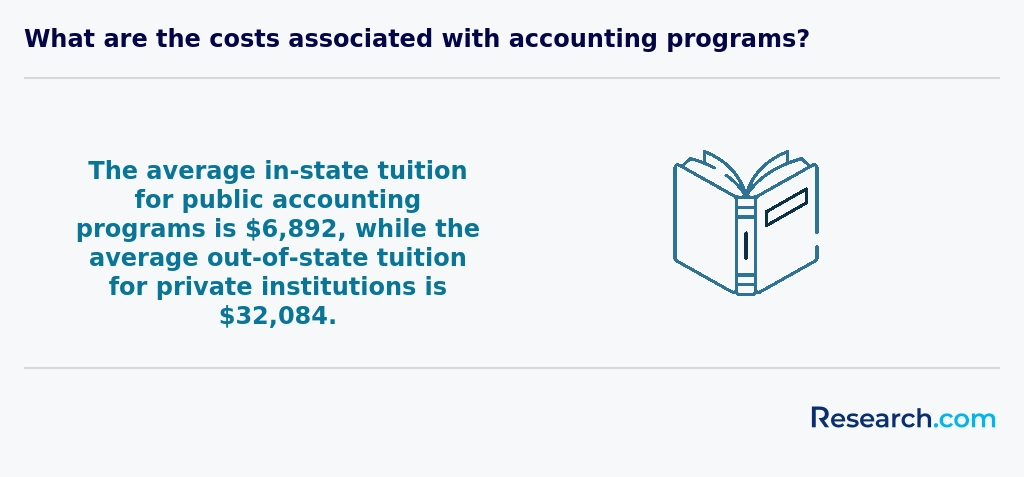
The average cost of pursuing an accounting degree in the West offers a fascinating blend of affordability and investment, inviting students to navigate choices that can shape their futures. On average, students face a median total tuition and fees around $46,187, but this amount shifts dramatically depending on whether you're classified as in-state or out-of-state. For many residents attending public universities like those in California or Washington, the in-state total cost often hovers closer to $12,204, making it a more wallet-friendly path for local students eager to dive into accounting.
Graduates from these institutions often share how accessing a quality education at this cost felt like a wise adventure, opening doors to rewarding internships and strong community networks. On the other hand, some students embraced the challenge of private colleges or moving from out-of-state, understanding that the higher investment - sometimes exceeding $40,000 annually - comes with unique perks like specialized programs and expansive alumni connections.
With the average cost of accounting degree programs in the West spanning this range, many future accountants find themselves plotting their route carefully. Beyond tuition, there are essential expenses like textbooks and software that add layers to the overall investment. For those looking for a more flexible path, wondering where to find the best blend of quality and value, exploring the best online accounting program in Colorado offers a promising option to consider as part of this exciting journey.

What financial aid is available to accounting degree students in the West?
Diving into an accounting degree in the West opens the door to a treasure trove of financial aid options designed to ease the journey. Imagine a student at the University of Southern California, thrilled to receive a merit-based scholarship recognizing their leadership and academic grit-this support can dramatically lighten the tuition load. Federal aid is a trusty companion for many, with FAFSA unlocking resources like Pell Grants offering up to $7,395 annually, or the Federal Direct Loan program providing loans with friendly interest rates that beat private options.
State programs like California's Cal Grant, which can cover up to $12,630 in tuition, or Oregon's Opportunity Grant, designed to support business and accounting enrollees, further brighten the path. Enthusiasts at the University of Washington often tap into state need grants or scholarships from professional groups like the AICPA, where applying could mean thousands of dollars toward textbooks and fees.
Work-study and paid internships add real-world sparkle, letting students earn while gaining hands-on experience-a win-win that many West Coast accounting grads cherish as they build careers.
How We Rank Schools and Programs
Our ranking methodology is designed to provide prospective students with a clear, unbiased view of the best accounting degree programs available in the West. We employ a comprehensive data-driven approach that considers several key factors: • Metrics such as graduate employment rates, alumni salary outcomes, faculty credentials, and accreditation status. • Student feedback and satisfaction surveys that offer qualitative insights into the learning environment and campus resources. • Comparative cost analysis, including tuition fees, financial aid opportunities, and additional expenses that can affect overall affordability. Our evaluation process also reviews specialized program features such as internship opportunities, access to modern technology in the curriculum, and partnerships with industry leaders. These elements are crucial in determining which institutions are best suited to prepare students for a competitive job market. For those looking to further boost their credentials, consider exploring our offerings on a basic accounting certificate as an effective stepping stone to enhance both your academic profile and practical expertise. By transparently sharing our ranking methodology, we aim to empower prospective students to make informed decisions and confidently pursue their education and career goals in accounting.
What are the prerequisites for enrolling in accounting degree program in the West?
Diving into an accounting degree in the Western US means gearing up with some solid academic groundwork. Graduates from popular schools often recall how mastering high school algebra and geometry gave them confidence when tackling financial analysis later. Many found that strong math skills became their trusty compass through tricky auditing classes at universities known for their rigorous programs.
Securing a spot usually involves achieving competitive SAT or ACT scores. For instance, at well-regarded public universities, the average SAT range for admitted students lands between 1050 and 1250, helping filter motivated explorers ready to embrace numbers and business logic.
Some adventurous students share how enrolling in introductory economics or business courses ahead of time sparked their curiosity about financial principles, making their college transition smoother. Those with AP credits or community college courses often embarked on their degree journeys with a helpful head start-saving time and easing the academic load.
For those setting sights on a Master of Accounting in the West, a bachelor's degree in accounting or a related field, coupled with foundational courses and some real-world accounting or finance experience, opens doors to new professional horizons.

Certification and Licensure: Pathways to Professional Credentials
Earning a recognized certification is often the next logical step after completing an accounting degree, as it validates your expertise and can significantly enhance your marketability. The most sought-after credential in the field is the Certified Public Accountant (CPA) designation, overseen by state boards of accountancy. To qualify for the CPA exam, candidates typically need 150 semester hours of college credit-already covered by most bachelor’s-plus-master’s pathways-along with specific coursework in accounting, business law, and ethics. Once exam sections in Auditing & Attestation, Business Environment & Concepts, Financial Accounting & Reporting, and Regulation are passed, an ethics exam and one to two years of supervised experience under a licensed CPA are required for licensure. Beyond the CPA, several specialty certifications allow graduates to target niche roles:
- Certified Management Accountant (CMA): Focuses on corporate financial management, budgeting, and strategic decision-making; requires a bachelor’s degree, two years of professional experience, and successful completion of a two-part exam.
- Certified Internal Auditor (CIA): Ideal for those pursuing careers in internal audit, risk management, and governance; candidates must hold a bachelor’s degree and pass three exam segments covering business knowledge, practice, and advisory skills.
- Certified Fraud Examiner (CFE): Designed for accountants specializing in forensic accounting and fraud investigation; requires a bachelor’s degree, two years of professional experience, and a four-part exam on fraud prevention, detection, and legal elements. For graduates looking to build foundational bookkeeping skills before tackling advanced certifications, enrolling in a certified bookkeeper course online can be a strategic first step. Such programs often cover essential topics like payroll, tax basics, and financial statement preparation-laying the groundwork for roles in small firms or as a stepping stone to the CPA. Maintaining any of these credentials requires ongoing professional education; for example, CPAs must complete 40 hours of Continuing Professional Education (CPE) annually, covering ethics, technical updates, and specialized topics. By strategically aligning your degree pathway with targeted certifications and fulfilling state licensure requirements, you’ll ensure both credibility and competitive advantage in the dynamic accounting job market.
What courses are typically in accounting degree programs in the West?
Studying accounting in the Western US often means diving into a rich mix of courses that bring the numbers to life. Imagine yourself at a university like the University of California or Portland State College, where you begin with Financial Accounting, mastering the art of preparing and analyzing balance sheets and income statements. Graduates often recall the rewarding "aha" moments during Managerial Accounting classes, where internal business decisions suddenly make sense.
Exploring Auditing is like uncovering a treasure map - you learn to examine financial records with a critical eye, ensuring accuracy and trustworthiness. Taxation courses prepare you to navigate the complex world of federal and state tax laws, a vital skill for any budding accountant in the West.
Technology enthusiasts enjoy Accounting Information Systems, blending accounting with innovative software tools that boost efficiency.
Courses in Business Law and Finance add layers of understanding that graduates appreciate when managing real-world risks and investments in their careers.
It's an adventurous mix, often complemented by electives like forensic accounting or international financial analysis, letting each student tailor their journey through this dynamic field.
What types of specializations are available in accounting degree programs in the West?
Diving into accounting degree specializations in the West reveals a fascinating variety of paths that spark curiosity and open doors to dynamic careers. In California and Washington, students often embrace financial accounting, immersing themselves in real-world cases that make financial statements come alive. Graduates share how this hands-on experience boosts their confidence in auditing and reporting roles.
Managerial accounting attracts those who love strategic thinking, budgeting, and guiding business decisions. Imagine working behind the scenes in a thriving Oregon company, analyzing costs and shaping growth - many graduates find this exhilarating. If federal and state tax laws pique your interest, specializing in taxation-especially in diverse West Coast markets-delivers rewarding challenges and valuable expertise.
Explorers interested in uncovering fraud may find forensic accounting irresistible, combining investigative instincts with number crunching. Meanwhile, innovations in data and systems fuel the rise of information systems accounting, where tech-savvy students at West Coast colleges blend accounting with IT to stay ahead.
For newcomers, exploring options like a basic accounting certificate helps build confidence before diving deeper. The variety of popular accounting majors Western US offerings means every curious mind can tailor their journey toward the perfect financial career adventure.
How do you choose the best accounting degree in the West?
Choosing the best accounting degree in the West feels like embarking on a thrilling quest through diverse academic landscapes. Graduates from renowned universities near vibrant cities like San Francisco recall how AACSB accreditation was their compass, guiding them toward programs known for high standards and strong industry respect. It's crucial to weigh affordable accounting degrees Western US options-public universities offer budget-friendly tuition averaging $7,500 to $12,000, while private colleges demand a steeper investment but often deliver unique specialization tracks.
Students often share stories of discovering specialized curricula in forensic accounting or auditing, which aligned perfectly with their career ambitions, boosting confidence in their direction. Internship opportunities near financial hubs add an adventurous twist, offering hands-on experience that graduates cherish. Navigating CPA exam eligibility across various states encourages a deeper dive into program requirements to avoid surprises. For those exploring alternative routes, a certified bookkeeper course online can open new doors along this winding journey.
What career paths are available for accounting degree students in the West?
Venturing into accounting career opportunities in the Western US opens doors to exciting and varied roles. Graduates from universities like UCLA or the University of Washington discover paths as Certified Public Accountants (CPA), where they dive into auditing, tax preparation, and consulting within dynamic industries ranging from technology to agriculture. Many find the thrill of managing corporate finances in booming companies, sharpening skills in budgeting and financial analysis, while others enjoy unraveling complex compliance puzzles in government accounting roles at agencies like the IRS.
Some graduates are drawn to the nonprofit sector, where their work ensures organizations maintain transparent and trustworthy financial practices-a rewarding role that sparks a sense of meaningful contribution. Experiences shared by alumni highlight how studying accounting in the West shapes their adaptability and analytical thinking in diverse environments. For those curious about cost-effective options along this path, checking out the Cheapest Online Accounting Degree Programs Ranking in Colorado proves invaluable, balancing quality education with financial investment.
Job prospects for accounting graduates in the West also include exciting roles such as financial analysts or internal auditors, combining curiosity with sharp analytical skills to explore company finances from every angle, making the profession an adventurous choice for many.
What is the job market for accounting degree in the West?
The job market for accounting degree holders in the West is as vibrant and promising as the diverse landscapes across California, Washington, and Colorado. Graduates from renowned universities often find themselves stepping confidently into roles across booming industries, from Silicon Valley's tech giants to Seattle's dynamic finance sector. These graduates describe their early work experiences as exciting, navigating complex financial regulations and contributing to companies where innovation meets meticulous accounting.
Opportunities abound for those embracing accounting career opportunities in the West, with starting salaries frequently outpacing national averages and climbing swiftly for those who advance. Many alumni from local colleges highlight how their education and preparation for the CPA exam unlocked doors to rewarding positions in public accounting and corporate finance, fueled by the region's strong emphasis on financial transparency and regulatory compliance.
For students curious about maximizing their success, many find that pairing their degree with the highest paying certifications gives them a clear advantage. The stimulating job outlook for accounting degrees Western US remains a beacon, encouraging ambitious learners to explore this path with enthusiasm and confidence.
Frequently Asked Questions About accounting
Accounting degree students in the Western United States can maximize their learning experience by engaging actively with both academic and practical opportunities. According to the National Association of State Boards of Accountancy, completing at least 150 credit hours is essential for CPA exam eligibility in most Western states, making extra coursework worthwhile.
Internships with local firms or corporate accounting departments provide valuable hands-on experience, complementing theoretical knowledge. Many universities in the West, such as UCLA and the University of Washington, offer strong connections to industry partners to facilitate internships.
Students should also leverage campus resources like tutoring centers and accounting clubs to deepen understanding and build professional networks. Regularly staying updated on changes from bodies like the Financial Accounting Standards Board (FASB) can prepare students for evolving industry standards.
The accounting field in the Western United States is evolving with several emerging niches gaining attention. One rapidly growing area is forensic accounting, which focuses on investigating financial fraud and disputes. According to the Bureau of Labor Statistics, employment in this specialty is expected to grow faster than average through 2030.
Another niche is environmental accounting, which integrates sustainability and regulatory compliance into traditional accounting practices. This reflects increasing corporate responsibility and government regulations around environmental impact.
Technology-driven roles such as data analytics and blockchain accounting are also expanding. Firms value accountants who can analyze large data sets and understand the implications of blockchain for secure transactions.
Graduates with accounting degrees in the Western United States should focus on gaining practical experience alongside their education. Internships are highly valued by employers; according to the American Institute of CPAs, over 75% of accounting internships lead to job offers.
Obtaining certifications, especially the CPA (Certified Public Accountant), significantly improves hiring prospects. In most Western states, candidates must complete 150 semester hours of education, pass the CPA exam, and gain relevant work experience to become licensed.
Networking through professional organizations, such as state CPA societies, helps students connect with potential employers.
Developing skills in accounting software like QuickBooks or Microsoft Excel is also essential in today's job market.
Employers in the Western US consistently prioritize a combination of technical and soft skills when hiring accounting graduates. Proficiency in accounting software, such as QuickBooks and SAP, is essential, as 78% of firms report using digital tools extensively (AICPA, 2023). Strong analytical skills enable graduates to interpret financial data accurately and support decision-making processes.
Additionally, communication skills are crucial since accountants must explain complex financial information clearly to non-experts. Attention to detail reduces errors in compliance and reporting, which is vital given the region's strict regulatory environment.
Ethical judgment also ranks highly, reflecting the profession's emphasis on trust and transparency. Lastly, familiarity with tax laws specific to states like California and Washington gives graduates a competitive edge in this market.
Finding internships related to accounting degrees in the Western United States often begins with utilizing university career centers. Many universities in states like California, Oregon, and Washington have established partnerships with local accounting firms and corporate finance departments.
The National Association of Colleges and Employers (NACE) reports that approximately 60% of internships lead to job offers, highlighting their importance. Students can also explore platforms like Handshake, which specialize in internship listings for college students.
Networking through accounting student organizations such as Beta Alpha Psi or attending regional accounting conferences further increases internship opportunities.
Additionally, applying early and tailoring resumes to highlight relevant coursework and software skills like QuickBooks or Excel can improve chances of securing internships.
An accounting degree in the Western United States significantly enhances career mobility and advancement opportunities. According to the U.S. Bureau of Labor Statistics, employment of accountants and auditors is projected to grow 7% from 2021 to 2031, faster than the average for all occupations. This demand reflects a steady market in California, Washington, and Oregon, where many large corporations and financial firms operate.
The degree provides essential qualifications for certifications such as the CPA (Certified Public Accountant), which employers highly value and often require for senior roles. Holding a CPA can increase salary potential by up to 10-15%, according to the American Institute of CPAs.
Graduates also gain flexibility, able to work in public accounting, corporate finance, government agencies, or nonprofits. A Western education in accounting often includes knowledge of local tax laws and regulations, making candidates more competitive in regional job markets.
Studying for an accounting degree in the West equips students with skills that extend beyond traditional bookkeeping and financial reporting. Many Western universities emphasize interdisciplinary coursework, combining accounting principles with finance, economics, information systems, and business law.
This broad educational approach prepares graduates for diverse roles such as financial analysis, auditing, and consultancy. The integration of technology and data analytics into accounting programs reflects industry trends, enhancing adaptability.
According to the National Center for Education Statistics, over 60% of accounting graduates in the Western U.S. take on jobs requiring knowledge from multiple business areas. This versatility meets employer demand for professionals who can navigate complex financial environments and collaborate across departments.
Choosing between a thesis and a non-thesis accounting degree in the West depends on career goals and learning preferences. A thesis program usually suits students aiming for research, doctoral studies, or specialized roles in accounting. It requires completing a substantial research project, enhancing critical thinking and analytical skills. Non-thesis programs focus more on coursework and practical knowledge, favoring those seeking immediate employment in the industry.
According to the National Association of State Boards of Accountancy (NASBA), about 60% of accounting graduates in Western states prefer non-thesis programs for faster entry into roles such as CPA or auditor. Thesis tracks often take longer but can strengthen a resume for academia or consulting.
Students based in the West who want to study accounting abroad have several options within the United States, which offers a wide range of accredited programs. According to the American Institute of CPAs (AICPA), over 600 institutions provide accounting degrees that comply with the generally accepted accounting principles and prepare students for CPA licensure.
Many universities offer specialized bachelor's or master's degrees in accounting, often featuring practical internships or partnerships with regional firms. States such as California, New York, and Texas host top-ranking schools, including University of Southern California, New York University, and University of Texas at Austin, known for their strong accounting curricula.
Furthermore, students can explore study-abroad programs linked to U.S. universities, combining international experience with accredited accounting education. These programs often integrate U.S. accounting standards (GAAP) with international financial reporting standards (IFRS), expanding career opportunities globally.
Part-time job opportunities that complement accounting degree education in the Western US are abundant and valuable. Positions such as bookkeeping assistants, tax preparers, and accounting clerks offer practical experience relevant to coursework. According to the U.S. Bureau of Labor Statistics, these roles often require basic knowledge in accounting principles, making them ideal for students still completing their degrees.
Working in campus finance offices or local CPA firms also allows students to develop technical skills in software like QuickBooks and Excel. Employers in California and Washington frequently seek candidates who balance education with hands-on work, boosting employability after graduation. Internships that pay part-time contribute further to understanding financial regulations and reporting standards.
Accounting students in the Western United States benefit from diverse networking opportunities essential for career growth. Universities often host accounting-specific events, such as guest lectures, workshops, and meet-and-greet sessions with local CPA firms and industry professionals. According to the National Association of State Boards of Accountancy (NASBA), nearly 70% of accounting jobs are found through professional networking.
Student organizations like Beta Alpha Psi and state CPA societies provide platforms to connect with peers and mentors. Additionally, internship fairs held at Western universities frequently attract top accounting employers, facilitating early professional relationships. These connections can significantly impact job prospects after graduation.
Alumni networks play a crucial role for accounting degree students in the Western United States by providing valuable connections and career opportunities. Graduates from schools in California, Oregon, and Washington often gain access to active networks that help with job placements, internships, and mentoring. For example, a 2023 survey by the National Association of Colleges and Employers found that 70% of students secured accounting roles through alumni referrals.
These networks also provide real-world insights and updates on industry trends, which are vital given the evolving accounting standards in the US. Furthermore, many Western universities host alumni events and workshops specifically for accounting students, fostering professional growth. Participation in these networks can significantly boost chances of CPA exam success and early career advancement.
Many universities in the Western US offer flexible accounting degree programs that allow students to tailor their studies to career goals. You can often choose elective courses focusing on areas like forensic accounting, taxation, or auditing. Selecting internships or cooperative education opportunities related to your interests helps gain practical experience.
Some programs provide options for accelerated paths to meet the 150 credit hours required for CPA licensure in states like California and Washington. Schools accredited by AACSB offer specialized tracks and networking opportunities beneficial for careers in public accounting or corporate finance. According to the Bureau of Labor Statistics, Western states have a strong demand for accountants, making targeted skills valuable.
Accounting students in the Western United States often face significant challenges related to the rigorous curriculum and high academic standards. According to the American Institute of CPAs (AICPA), the pass rate for the Uniform CPA Exam is around 50%, highlighting the difficulty of meeting professional certification requirements.
Many students struggle to balance demanding coursework with internships and part-time jobs. Time management becomes critical as they prepare for complex subjects such as auditing, taxation, and financial reporting.
Moreover, the rising cost of education in Western states adds financial pressure. Data from the College Board indicates that average tuition fees for public universities in California and Washington have increased by over 20% in the past five years, affecting students' ability to finance their studies.
With an accounting degree in the Western United States, you can pursue several respected professional certifications that enhance career opportunities. The most recognized is the Certified Public Accountant (CPA) license, required for many public accounting roles. To qualify, candidates must complete 150 semester hours, meet state-specific experience requirements, and pass the Uniform CPA Exam. According to the California Board of Accountancy, CPA candidates in California increase their earning potential by up to 40% compared to non-certified accountants.
The Certified Management Accountant (CMA) is another valuable credential focused on financial management and strategic planning, offered by the Institute of Management Accountants.
Additional credentials include the Certified Internal Auditor (CIA) and Certified Fraud Examiner (CFE), which broaden job prospects in audit and fraud prevention.
When applying to accounting programs in the Western US, a strong application combines academic achievement and clear career goals. Most reputable schools look for a minimum GPA of 3.0, with competitive programs preferring 3.5 or higher, as reported by the National Center for Education Statistics (NCES).
Highlight relevant coursework in math, economics, or business to demonstrate your readiness. Including internships or work experience in finance or accounting can significantly enhance your profile.
Personal statements should clearly express your motivation for studying accounting and your long-term aspirations within the field. Tailor each essay to the program's unique strengths.
Letters of recommendation from professors or employers familiar with your quantitative skills add credibility.
Lastly, prepare for and submit strong GRE or GMAT scores if required, as many Western programs use these as part of holistic reviews.
The global perspective on an accounting career reflects its strong demand and versatility, especially for students in the West considering an accounting degree. In the United States, accounting remains a stable profession with the Bureau of Labor Statistics projecting a 6% growth in employment from 2022 to 2032, faster than average for all occupations. This growth is fueled by increasing regulatory requirements and globalization of business.
Accounting professionals with international certifications, such as the CPA (Certified Public Accountant) or ACCA (Association of Chartered Certified Accountants), often find diverse opportunities worldwide. Many Western universities emphasize these credentials in their curricula to prepare students for a competitive global market.
Moreover, advancements in technology and data analytics are reshaping accounting practices, requiring new skills and continuous learning. According to the American Institute of CPAs, familiarity with emerging technologies is becoming essential for accountants.
Overall, an accounting degree in the West offers both local and international career mobility, supported by solid education frameworks and recognized credentials.
Gaining practical experience while studying for an accounting degree in the West is crucial for career readiness. Many universities offer internship programs in partnership with local businesses and accounting firms. These internships allow students to apply classroom knowledge to real-world accounting tasks, enhancing skills and employability.
Additionally, students can participate in cooperative education (co-op) programs that alternate semesters of study with full-time work experience. According to the National Association of Colleges and Employers (NACE), over 60% of accounting graduates secure jobs through internships or co-op roles.
Joining campus accounting clubs or chapters of organizations like the American Institute of CPAs (AICPA) also provides networking opportunities and practical exposure. Some schools integrate case studies and simulations, giving hands-on practice in auditing, tax preparation, and financial analysis.
Choosing the right concentration within an accounting degree program in the Western US often depends on your career goals and interests. Common concentrations include tax accounting, auditing, forensic accounting, and managerial accounting. Data from the Bureau of Labor Statistics indicates that managerial accounting roles in the West are growing faster than average, making this a promising path for job seekers.
Consider programs accredited by the Association to Advance Collegiate Schools of Business (AACSB) or recognized by the American Institute of CPAs (AICPA), as these are highly valued by employers. Additionally, explore concentrations that offer practical experience or internships, which are prevalent in Western universities. This hands-on learning enhances employability in competitive markets like California and Washington.
Ultimately, analyze the curriculum and career services each school offers to align with your interests and regional job trends.
Top Trending Accounting Rankings
See What Experts Have To Say About Studying Accounting
Read our interview with Accounting experts

John Wermert, Ph.D., CPA
Accounting Expert
Associate Professor of Accounting
Middle Tennessee State University

Yaw M. Mensah
Accounting Expert
Professor and Interim Vice Dean for Strategic Partnerships
Rutgers Business School

References
- How Long Does It Take to Get an Accounting Degree? https://www.miamiherald.com/careers-education/how-long-does-it-take-to-get-an-accounting-degree/
- How to Choose a Degree in Accounting | Accounting.com https://www.accounting.com/resources/choosing-a-program/
- Work Experience https://www.streets.uk/work-experience/
- Accounting Degree Requirements You Should Know https://www.devry.edu/blog/accounting-degree-requirements.html
- Accounting Work Experience in London | Guaranteed work experience https://www.kbmtr.co.uk/accounting-work-experience.php
- Most Affordable Finance Degrees in the Western U.S. | What is a Financial Planner? | What does a Financial Planner do? https://www.financialplannerworld.com/most-affordable-finance-degrees-in-the-western-u-s/
- How Long Does It Take to Get an Accounting Degree? https://www.warnerpacific.edu/blog/how-long-does-it-take-to-get-accounting-degree/
- Best Niches for Accounting Firms, Ranked by Profitability https://dreamfirms.com/insights/best-niches-for-accounting-firms/
- Networking opportunities https://www.saica.org.za/members/member-info/member-value-proposition/networking-opportunities/
- Finance and Accounting with a Double Degree Post ... https://vistula.edu.pl/en/major/finance-and-accounting-with-a-double-degree